Guides
Language
EnglishCurrency
US dollar · $GetYourGuide shows prices in the currency you choose.
Guide · The rock itself
How was Uluru formed, and how big is it really?
How was Uluru formed? It began as sand washed off long-vanished mountains, was buried under a sea, turned to stone, tilted on its end and slowly uncovered. Here is that story, the rock's real size, and why it burns red at sunset.
Editorial team, ulurusunset.comUpdated October 22, 2026Reading time about 6 minutes26 sources
From mountain sand to a buried fan
The story starts with mountains that are mostly gone. Parks Australia explains that Uluru and Kata Tjuta started to form about 550 million years ago, when the Petermann Ranges west of Kata Tjuta were much taller than they are now.1 Rain running off those mountains carried sand and rock down onto the plains and dropped it in big fan shapes.6
There were two fans, and they were not alike. One was mainly water-smoothed rock, the other mostly sand.6 That difference, set down in the sediment more than half a billion years ago, can still be seen in the landmarks today: one smooth and single, the other a cluster of rounded domes.7
Then the sea arrived. Around 500 million years ago the whole area was covered by water, and sand and mud settled on the seabed over the fans.7 The weight of that new seabed pressed the fans into rock: the sandy fan became the sandstone of Uluru, and the rocky fan became the conglomerate of Kata Tjuta.7
Deep time
From mountain sand to a sunset icon
-
550 million years ago
Fans of sand and rock
-
500 million years ago
Under the sea
The fans are buried and turn to rock.7
-
400 million years ago
Tilted upright
Uluru tilts 90 degrees.8
-
Last 300 million years
Erosion
Softer rock wears away around it.9
-
30,000+ years
People in the Centre
Aboriginal people in Central Australia.10
-
1987 and 1994
World Heritage
Natural, then cultural recognition.11
Tilted on its end, then uncovered
The next chapter is movement. 400 million years ago the sea disappeared, and as the earth's tectonic plates shifted, the rocks folded and tilted.8 Kata Tjuta tilted only slightly, but Uluru tilted 90 degrees.8 The layers that once lay flat under the sea were turned on their end.
Over the last 300 million years, the softer rocks around them eroded away and left Uluru and Kata Tjuta standing above the plain.9 What you see is the hard core that survived, not a pile that was built up. It is easier to grasp in the evening, when low sunlight picks out every ridge and furrow on the face of the rock.
So when people ask how old Uluru is, there are two honest answers. The sandstone itself is about half a billion years old, as Parks Australia puts it.4 The shape you photograph at sunset is the result of erosion over the last 300 million years, a landscape that is still being worn down today.9 A wet day at Uluru is worth seeing rather than avoiding: Parks Australia notes that the rock looks shiny when it is wet.12
Two fans, two rocks
Uluru and Kata Tjuta compared
See it yourself
Where the geology shows best
Pick what you want to see
These magnificent rock formations are actually a lot bigger than they appear - like icebergs, most of their mass is below the surface.
How big is Uluru?
Bigger than it looks, and it looks enormous. Uluru rises 348 metres above the surrounding plain, higher than the Eiffel Tower, the Chrysler Building in New York or the Eureka Tower in Melbourne.3 Walk right around its base and you cover a circumference of 9.4 km.4
Its weight has even been estimated. In 2018 the Northern Territory Geological Survey calculated it for the ABC TV series Catalyst at 1,425,000,000 tonnes, and that figure counts only the part above the ground.18 The part below is the bigger story: like icebergs, Uluru and Kata Tjuta hold most of their mass beneath the surface.5
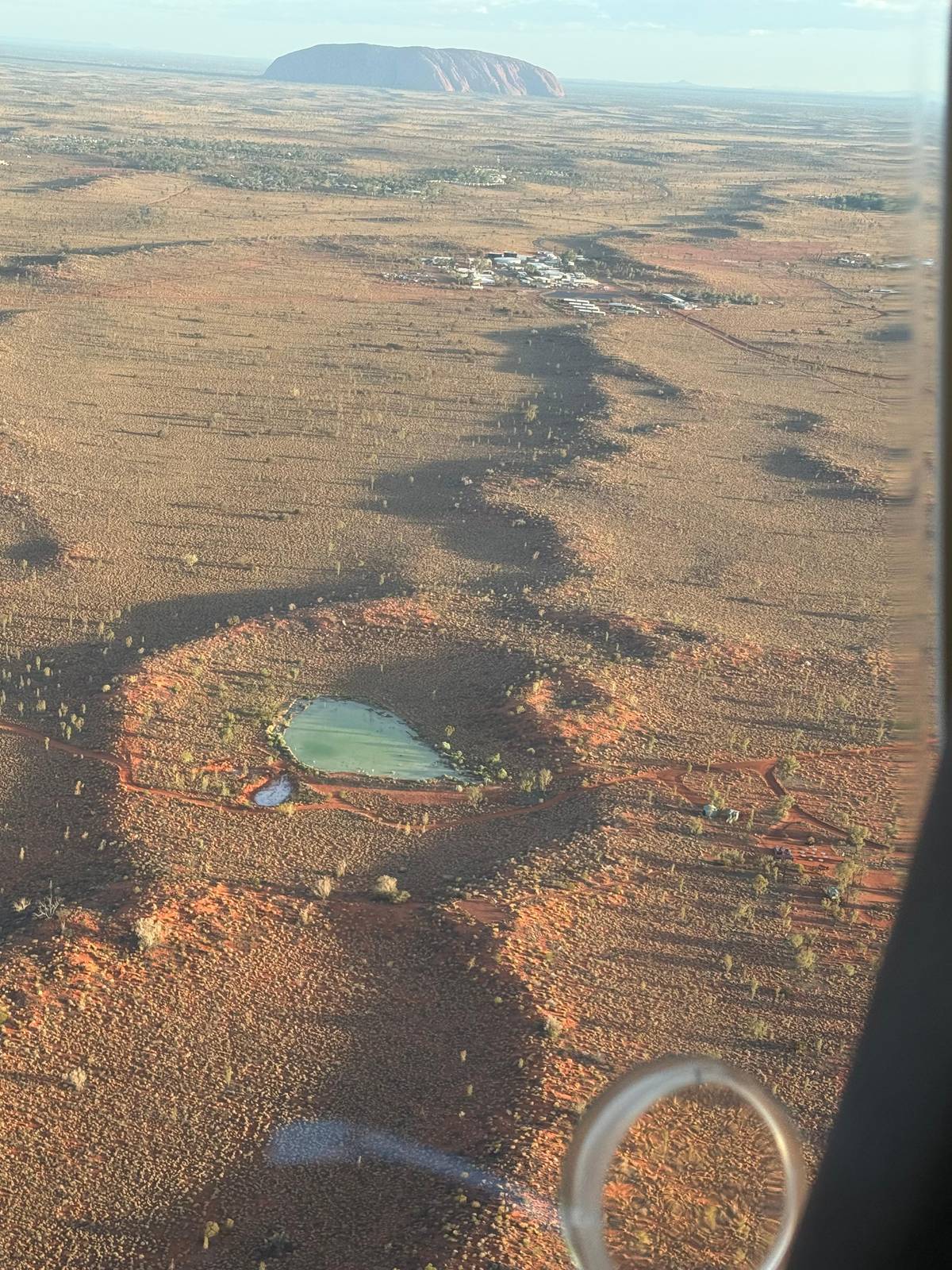
Parks Australia describes both as only the tips of huge rock slabs that continue underground for up to 6 km.5 Next door, Kata Tjuta's tallest dome rises 546 metres above the plain, so it is in fact the taller landmark, though Uluru is the one people picture.13 From a helicopter they stand in the same view, and the gap between them, filled with dunes and scrub, shows how much rock has been worn away around both.
Checklist
Reading the rock on your visit
Look for
- Long parallel lines of the tilted layers
- Grey rock inside sheltered hollows
- Dark streaks where water runs after rain
Respect
- No photos of signed sensitive sites
- Stay on marked tracks
- Ask before photographing people
Video
How was Uluru formed?
No video data loads before you press play.
Why the rock is red, and grey inside
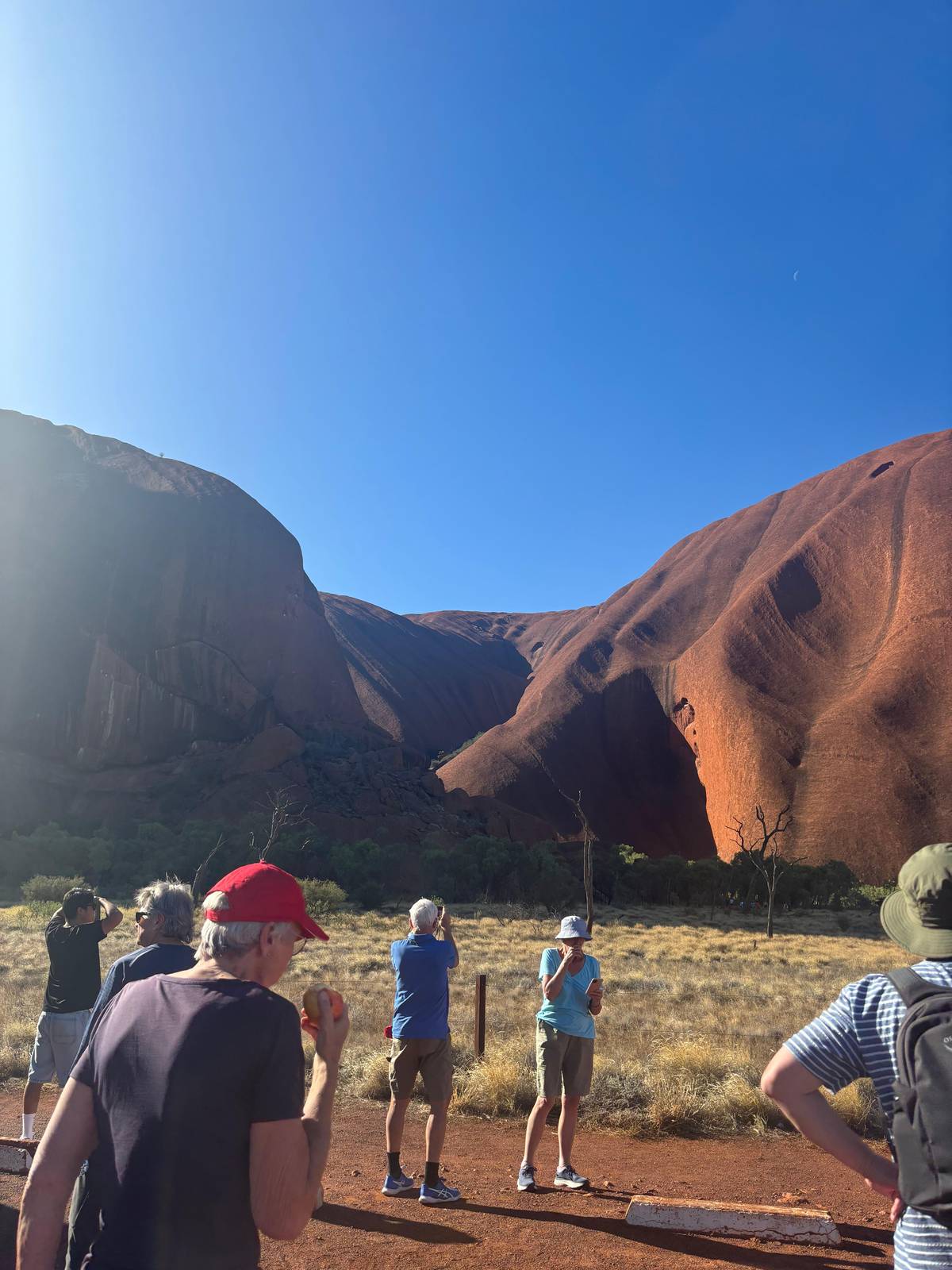
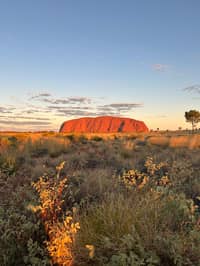
Uluru is a type of rock called arkose, and if you look closely along the base its surface is flaky red with grey patches.2 The flakes are pieces of rock left after water and oxygen have broken down minerals in it.2 The red is rust: iron found naturally in arkose, oxidised at the surface.2
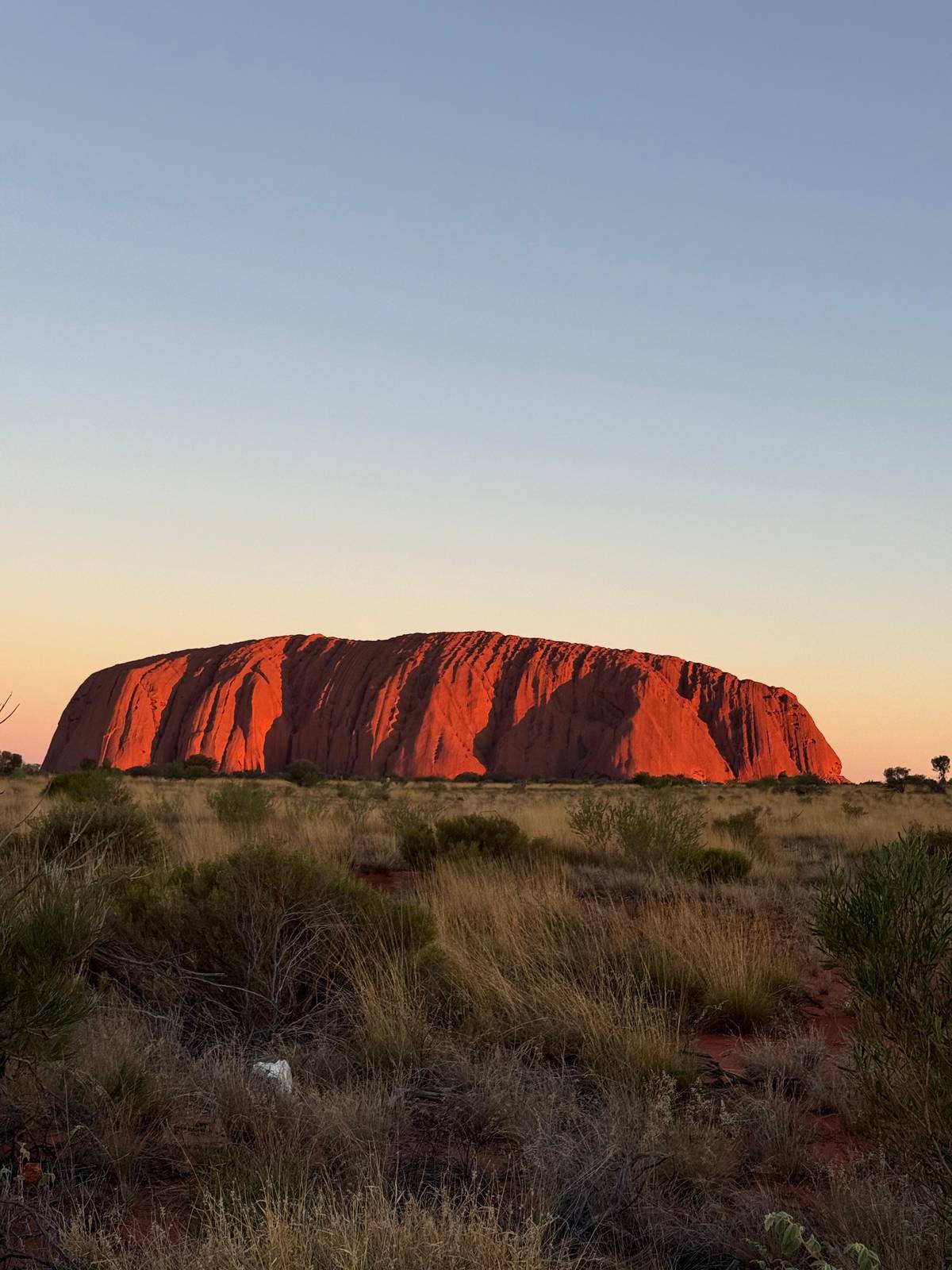
The grey is the rock's original colour, and you can see it inside many of Uluru's caves, where the surface has been sheltered.2 It is a striking thought at sunset: the glowing wall in front of you is a thin coat of rust on a grey stone, lit by the last low light of the day.
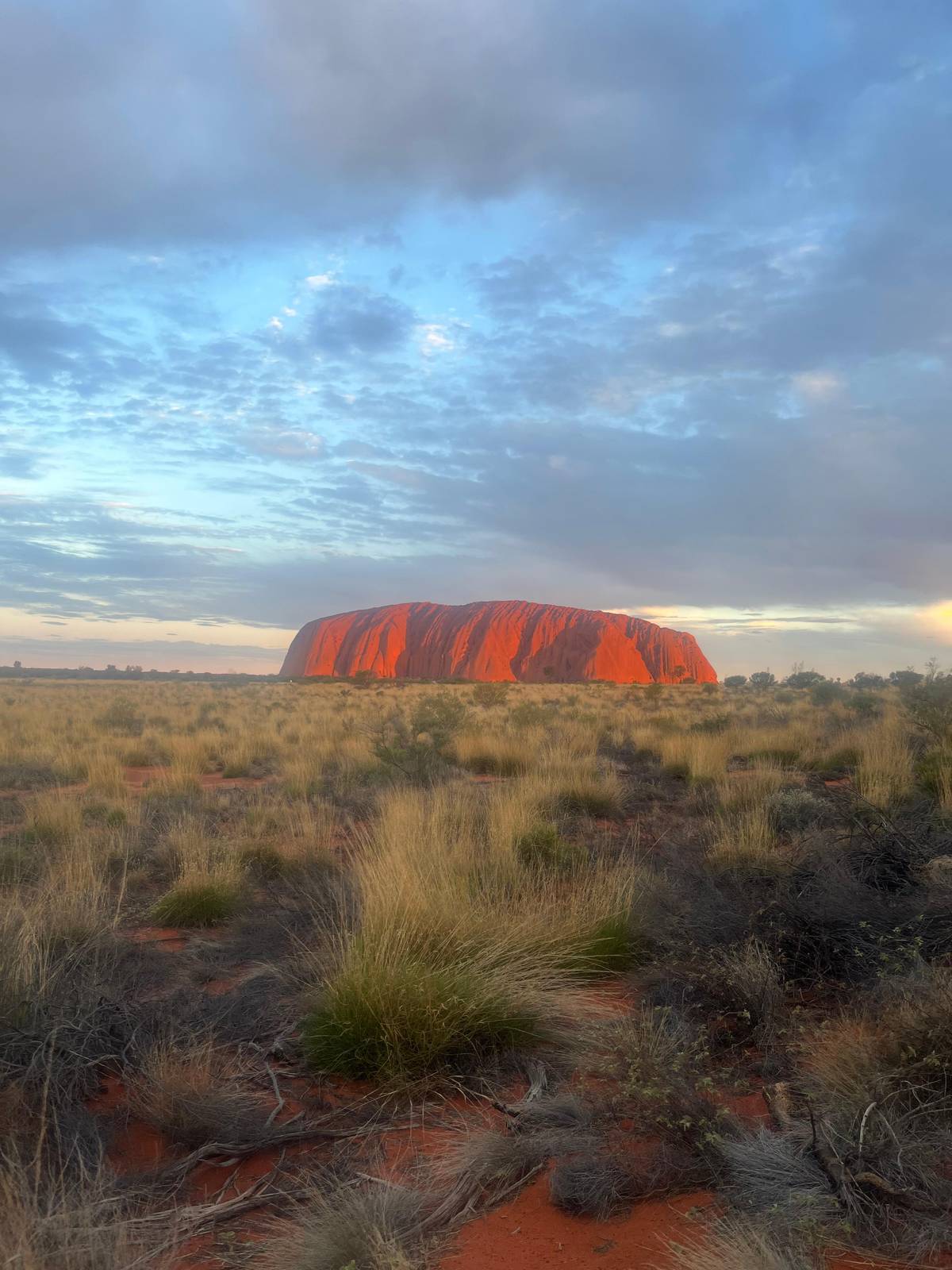
That light is what makes the colours come alive. In Parks Australia's words the rock is at its finest at either end of the day, when low golden light wakes up its colours; under cloud it turns brooding, and after rain it gleams.1912 Kata Tjuta tells a different story in close-up: boulders and pebbles, largely granite and basalt, held together by a matrix of sand and mud.14
Older than the science: Uluru in Anangu law
Geology is one way to explain the rock, and it is the one this page is about, but it is not the oldest. For Anangu, its Traditional Owners, Uluru is inseparable from Tjukurpa, traditional law, and the actions of the creation ancestors are still visible around it.20 For tens of thousands of years Uluru has been a sacred place for Anangu, and digs in the region show people living in Central Australia for upwards of 30,000 years.2110
The name itself comes from that culture: the word Uluru is a Pitjantjatjara proper noun, with no English equivalent.22 The explorer William Gosse became the first non-Aboriginal person to see it in 1873 and named it Ayers Rock after Sir Henry Ayers, the Chief Secretary of South Australia.23
UNESCO recognised both sides of the story. UNESCO first listed the park in 1987, for its geology, wildlife, plants and beauty, and recognised its cultural landscape as well in 1994.11 Australia has just four sites listed for both natural and cultural values, and this park is among them.24 Some features of the rock carry meaning that should only be seen in place and by specific people, which is why Parks Australia asks that certain sites are never photographed.25
Seeing the geology at sunset
You do not need a hammer or a textbook to read this rock. Stand at the car sunset viewing area and watch: as the sun sinks behind you, the surface turns from pinkish hues to fluorescent orange and deep red, the rust lit at a low angle.15 The texture of the surface shows best in that raking light: every flake, groove and hollow casts its own small shadow, and the rock looks less like a smooth wall and more like the worn, ancient stone it is.
From the end of the dune walk near the bus area you see Uluru and Kata Tjuta together, the sandstone fan and the conglomerate fan side by side, as the sun sets behind the dunes towards Kata Tjuta.16
The displays in the Cultural Centre's information room cover how Uluru was formed, alongside Pitjantjatjara language and oral histories, so they are worth reading before your evening at the viewing area.26 The tour booked on this site stops there before taking you back to the rock for the sunset.
Pick your evening
A waterhole by day, the rock red at dusk
Hotel pick-up, the Kuniya Walk, the Cultural Centre and sunset drinks; cancel free until a day before.


You ask,we answer.
How old is Uluru?
About half a billion years. Its sandstone is about that old; formation began about 550 million years ago.41
How tall is Uluru?
348 metres. That is its height above the surrounding plain.3
How far is it around Uluru?
9.4 km. That is the circumference of its base.4
How much does Uluru weigh?
About 1,425,000,000 tonnes above ground. The Northern Territory Geological Survey's 2018 estimate.18
Is more of Uluru underground?
Yes, most of it. The slab continues underground for up to 6 km.5
Why is Uluru red?
Rusting iron. The red is iron in the arkose; the grey is the original colour.2
Sources
The sources for this guide
- 1Parks Australia, Uluṟu-Kata Tjuṯa National ParkGeology↩
- 2Parks Australia, Uluṟu-Kata Tjuṯa National ParkGeology↩
- 3Parks Australia, Uluṟu-Kata Tjuṯa National ParkAmazing facts↩
- 4Parks Australia, Uluṟu-Kata Tjuṯa National ParkUluṟu↩
- 5Parks Australia, Uluṟu-Kata Tjuṯa National ParkGeology↩
- 6Parks Australia, Uluṟu-Kata Tjuṯa National ParkGeology↩
- 7Parks Australia, Uluṟu-Kata Tjuṯa National ParkGeology↩
- 8Parks Australia, Uluṟu-Kata Tjuṯa National ParkGeology↩
- 9Parks Australia, Uluṟu-Kata Tjuṯa National ParkGeology↩
- 10Parks Australia, Uluṟu-Kata Tjuṯa National ParkAmazing facts↩
- 11Parks Australia, Uluṟu-Kata Tjuṯa National ParkWorld heritage↩
- 12Parks Australia, Uluṟu-Kata Tjuṯa National ParkPhotography↩
- 13Parks Australia, Uluṟu-Kata Tjuṯa National ParkAmazing facts↩
- 14Parks Australia, Uluṟu-Kata Tjuṯa National ParkGeology↩
- 15Parks Australia, Uluṟu-Kata Tjuṯa National ParkUluṟu car sunset viewing area↩
- 16Parks Australia, Uluṟu-Kata Tjuṯa National ParkUluṟu bus sunset viewing area↩
- 17Parks Australia, Uluṟu-Kata Tjuṯa National ParkOpening hours↩
- 18Parks Australia, Uluṟu-Kata Tjuṯa National ParkAmazing facts↩
- 19Parks Australia, Uluṟu-Kata Tjuṯa National ParkUluṟu↩
- 20Parks Australia, Uluṟu-Kata Tjuṯa National ParkUluṟu↩
- 21Parks Australia, Uluṟu-Kata Tjuṯa National ParkUluṟu climb closure↩
- 22Parks Australia, Uluṟu-Kata Tjuṯa National ParkAyers Rock or Uluṟu?↩
- 23Parks Australia, Uluṟu-Kata Tjuṯa National ParkAyers Rock or Uluṟu?↩
- 24Parks Australia, Uluṟu-Kata Tjuṯa National ParkWorld heritage↩
- 25Parks Australia, Uluṟu-Kata Tjuṯa National ParkPhotography↩
- 26Parks Australia, Uluṟu-Kata Tjuṯa National ParkCultural Centre↩
Keep reading